by Carla Bianpoen
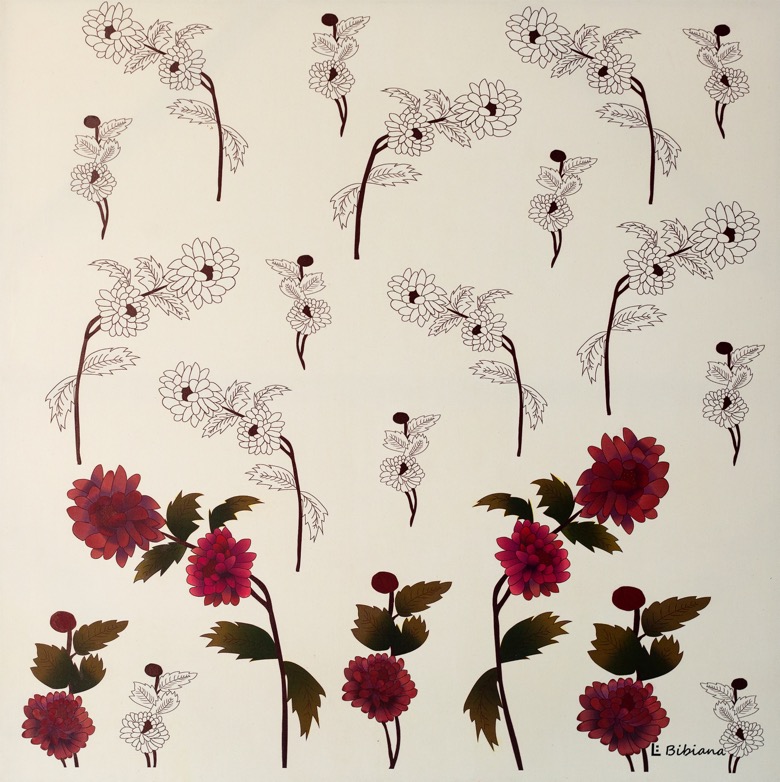
Amidst the rapid rise of technology, new forms of art are emerging. Intersecting with technological innovation and embodying character and strength that resonate with the spirit of the time, multimedia artist Bibiana Lee (b. 1956) has innovatively created a new way of appreciating batik by applying digital technology.
Whilst batik is usually associated with cloth, in Bibiana’s works it can be experienced through its symbols.
Bibiana Lee is particularly drawn to exploring Batik Tiga Negeri, a unique form of batik symbolising acculturation, bringing together Chinese, Dutch, and Javanese characteristics. It is marked by birds, phoenixes, flowers, and mountain motifs. Typically, this batik is dyed in three different places: red in Lasem on the north coast of Java, brown in Solo in Central Java, and blue in Pekalongan, another north coast town.
Whilst we often think of batik as cloth, what is particularly interesting are the symbols that cover it.
Bibiana Lee uses AR (Augmented Reality), a technology that overlays digital information such as images onto the real world in real time. Playfully, using a programmed smartphone, she brings these symbols closer to our presence, inviting us to ponder the deeper meanings of the cloth.
One of her works shows a qilin emerging from the painting’s frame, as if heading straight towards us. The qilin, an auspicious mythical creature in Chinese mythology, often referred to as the Chinese unicorn, is a chimeric beast symbolising fortune, prosperity, and wisdom. It is typically depicted with a dragon-like head, antlers, a deer-like body, scales, and an ox tail.
Using AR to access symbolic meaning is an uplifting experience. Batik Tiga Negeri factually denotes diversity, which also resonates with Indonesia’s national motto, Bhinneka Tunggal Ika.
This uplifting experience may be read as an optimistic gesture amid tensions in times of distress, reflecting a direction in Bibiana’s oeuvre, which often addresses the human condition of the less fortunate and the downtrodden.
Her chronicles of discrimination are notably expressed in a series on fine porcelain, spanning from 1740 to the present. She uses porcelain (china) as a metaphor, referencing the English word “china” to denote the fragile position of the Chinese community in Indonesia.
Another iconic installation is her interactive punching bags featuring the text I Am Not a Virus, created in response to the discrimination faced by Asian-looking individuals during the COVID-19 pandemic.
Her most recent installation will be featured in the exhibition On the Map, running at the National Gallery of Indonesia until 30 June 2026.