For Jakarta’s culinary cognoscenti, Turkuaz has never been just a restaurant. Under the stewardship of Chef-Owner Sezai Zorlu, it stands as a custodian of Turkish gastronomy shaped by memory and craft. Following its departure from Jl. Gunawarman, Turkuaz now re-emerges on Jl. Ciranjang in a reimagined setting that not only houses the restaurant, but deepens its narrative.
Photos courtesy of Studio Choros and Turkuaz
Set on a prominent corner, the building presents itself with restraint. A crisp white façade forms a quiet backdrop to stained-glass panels centred with the red tulip, a symbol deeply rooted in Turkish culture. The composition is measured, balancing stillness and ornament, anonymity and identity.
Arrival is carefully choreographed. A red canopy extends into a carpeted path, leading to a short ascent framed by gold-polished handrails. A timber door with stained glass marks the threshold, crowned by a blue eye amulet. By the time guests step inside, the city begins to recede.
The foyer unfolds vertically. Its ceiling rises to nearly eight metres, recalling the form of a dome without replicating it. Realised by the project architect following Sezai’s brief, the varied ceiling heights establish spatial hierarchy. Interior designer Fikr Alhaq (Al) of Studio Choros builds upon this framework, using shifts in volume to guide the experience.
The foyer’s openness accommodates both diners and guests heading upstairs, while the dining area beyond introduces a lower ceiling and a more intimate atmosphere. This transition from grandeur to warmth defines the spatial sequence.
A chandelier anchors the foyer, surrounded by personal artefacts. A portrait of Sezai’s mother, the ASEAN 50th Anniversary Certificate gifted by Indonesian art collector Rudy Akili, and an 1885 Le Petit Journal print presented by Tan Hung Seng collectively embed memory into the space.
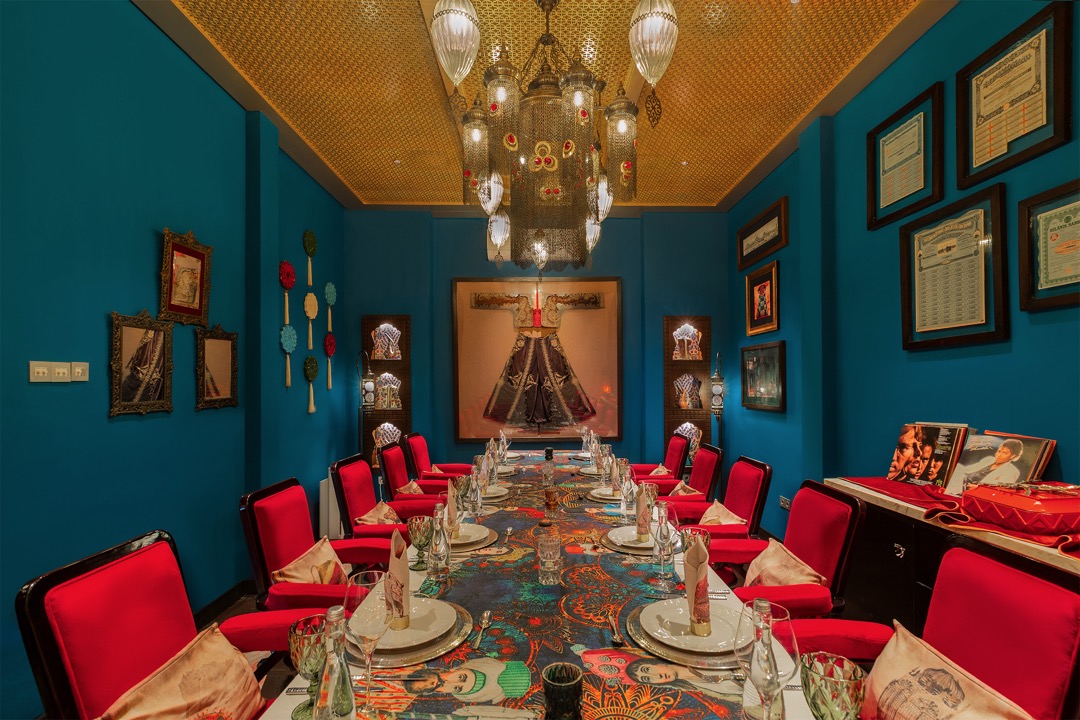
Relocating Turkuaz required more than transfer. Its collection of furniture and artefacts was reinterpreted through custom wallpapers, laser-cut panels, and layered ceiling treatments. The visual language shifts toward a more universal expression, positioning Turkuaz globally while retaining its Turkish essence.
The ground floor is clearly organised, with a central smoking room, private dining areas, a bar, and a non-smoking section. Ceiling compositions, particularly in the smoking area, integrate lighting and conceal services within layered geometries of steel, wood, and acrylic.
Ultimately, Turkuaz reads as a personal landscape. Sezai’s presence is felt throughout, from the interiors to the dining experience. The Sultan Grill Platter offers a generous selection of kebabs for sharing, while the signature kuzu incik, a slow-cooked lamb shank, reflects depth and precision. Beneath its richness lies discipline. A level floor ensures smooth circulation and efficient service. Even in its finest details, functionality remains inseparable from design.
Turkuaz brings together architecture, interior, and gastronomy in a coherent whole. It promises a dining experience shaped by memory, craft, and enduring hospitality.