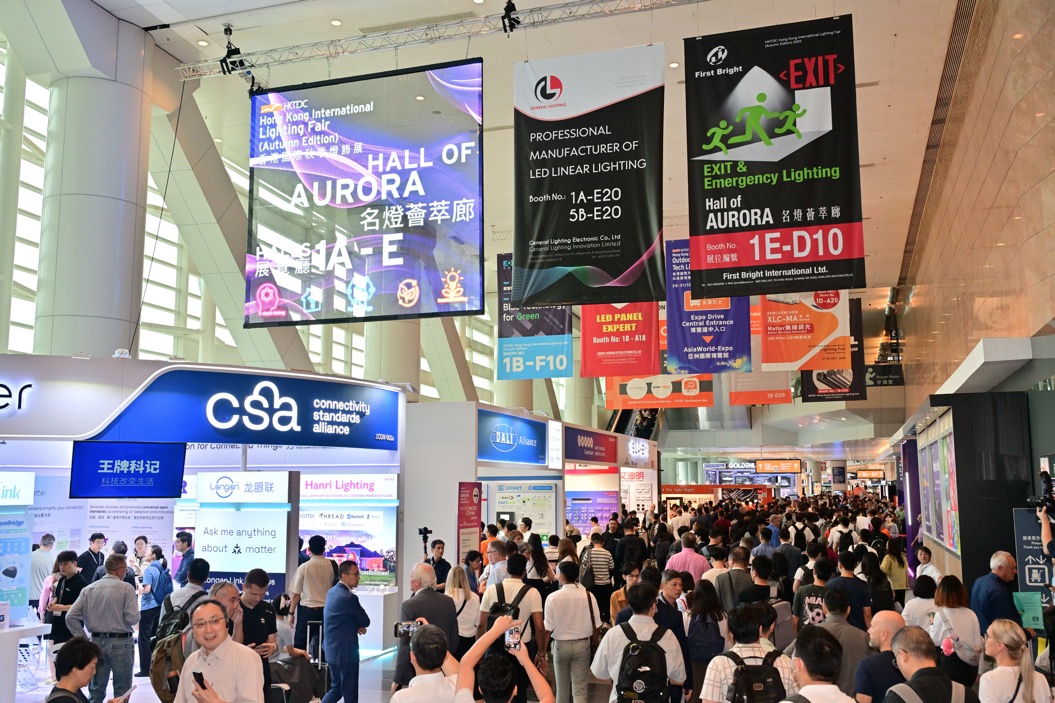
Indonesia Design visited Hong Kong to cover the 2025 International Lighting Fair, the Outdoor and Tech Light Expo, and Eco Expo Asia. The entire event was where advances in lighting, urban technology, and green innovation revealed the region’s evolving design landscape.
Hong Kong reaffirmed its position as a leading platform for design, technology, and environmental advancement. The fairs attracted the participation of some 62,000 buyers from 141 countries and regions, underscoring their international significance.
Jenny Koo, deputy executive director of the HKTDC, noted that the fairs brought together leading brands showcasing cutting-edge lighting, smart systems, and diverse green technologies. Strong participation from Mainland China, India, Korea, the United States, and Southeast Asia reflected the growing appetite for sustainable and future-ready urban solutions. Eco Expo Asia also welcomed Tse Chin-wan, Secretary for Environment and Ecology of the HKSAR Government, who premiered the second season of Enchanting China and engaged with students, underscoring Hong Kong’s commitment to sustainability education.
Market Confidence in AI-Driven Era
A survey involving more than seven hundred exhibitors and buyers revealed optimism, with 61 percent expecting sales growth in the next two years. Artificial intelligence emerged as the most significant growth driver, followed by the rise of smart-city development. We highlighted ASEAN, India, and the Middle East as key markets to watch. Despite broader economic uncertainties, most respondents reported minimal impact from recent tariff adjustments.
Lighting Meets Wellbeing
The Hall of Connected Lighting demonstrated how lighting is rapidly evolving into an interactive and multisensory discipline. Signify’s debut of the VitaUp Vitamin D3 Modules attracted well over one hundred potential buyers, with projected orders of EUR 1 to 2 million. Casambi Technologies impressed visitors with an immersive installation that seamlessly shifted between different environment settings, generating substantial client interest within the first few hours. Bweetech Electronics Technology showcased natural-language lighting customisation and secured an onsite order worth RMB 8 million, alongside additional inquiries from across Asia and the United States.
Complementing the product showcases was an extensive programme of seminars. A standout session came from lighting designer Tino Kwan, whose masterclass explored how lighting shapes mood, enhances functionality, and transforms the character of interior spaces. His approach emphasised lighting as both an art form and a contributor to personal wellbeing.
Smart Solutions for Future Cities
At AsiaWorld-Expo, the Outdoor and Tech Light Expo highlighted technologies designed for future-ready cities. Smart poles integrating lighting, sensors, communication systems, and emergency features emerged as a focal point of discussion. Freelux Lighting Appliance reported strong interest from buyers spanning Africa, Europe, the Middle East, South America, and South East Asia, with projected orders valued at USD 2 to 3 million. Long-term participant Trient Trading also made significant procurement plans for office and hospitality projects, estimating orders of USD 1.6 million.
Green Innovation for a Changing World
Eco Expo Asia gathered exhibitors focused on carbon neutrality, circularity, and ESG advancement. With participants from thirteen countries and regions, the fair served as a critical platform for international collaboration. Infore Enviro shared that they met stakeholders from across Asia and expected overseas revenue growth exceeding 200 per cent.
Startups from the Hong Kong Science and Technology Parks network generated projected orders of HK$15 million, reflecting the region’s thriving innovation ecosystem. Dunwell Engineering anticipated an increase of twenty percent in its annual revenue due to leads secured at the fair, while Hungary’s Oxyma Systems explored hydrogen-related partnerships valued at up to USD 5 million.
Regional Implications and Opportunities
The hybrid Exhibition Plus platform extended business matching beyond the event period, strengthening the fairs as year round hubs of innovation and exchange.
Across lighting, infrastructure, and environmental solutions, a common thread emerged. Technology is shifting from a supporting feature to a central design element. Lighting now interacts with users, adapts to settings, and considers wellbeing. Urban infrastructure increasingly depends on integrated data and communication systems. Green technologies are transitioning from conceptual frameworks into essential tools for planning, policymaking, and implementation.
For Indonesia and the wider South East Asian region, these developments align closely with ongoing urban expansion, green building standards, and smart city aspirations. The ideas and innovations presented in Hong Kong offer practical pathways for governments, developers, and planners seeking to improve resilience, efficiency, and liveability.
The collective message resonating across the three fairs pointed toward a future shaped by smarter and cleaner innovation. Asia’s next chapter will be illuminated not only by advances in lighting but by integrated, sustainable, and interconnected solutions capable of transforming urban environments for decades to come.