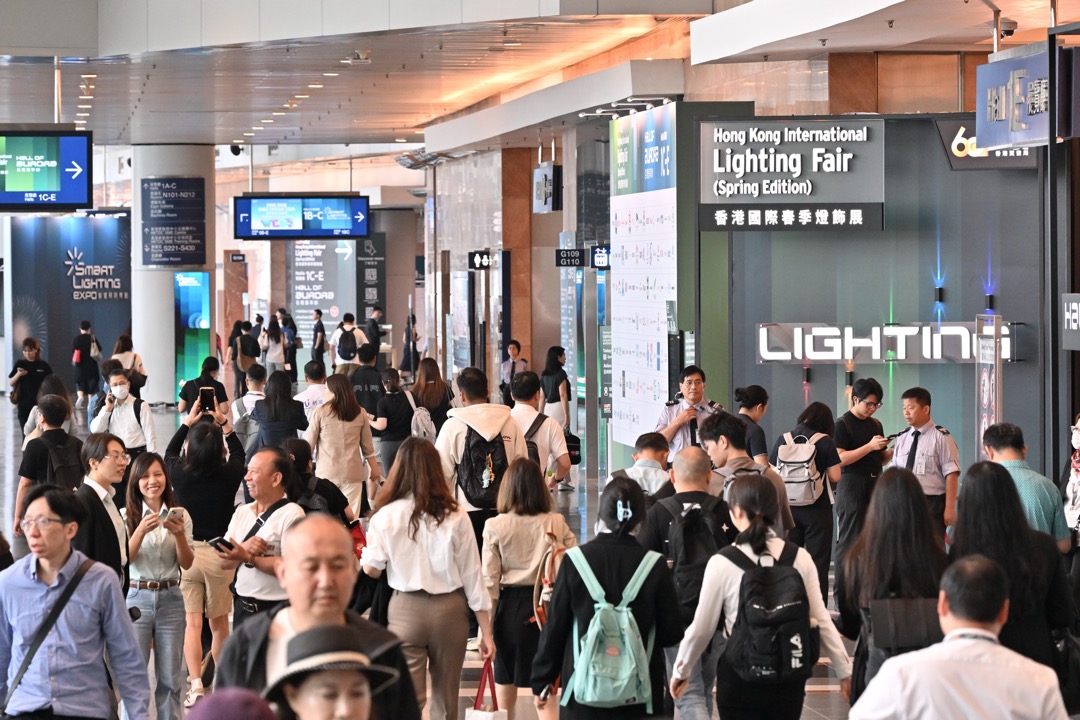
Indonesia Design travelled to Hong Kong for the 2026 Smart Lighting Expo and Hong Kong International Lighting Fair Spring Edition, where we encountered an industry transforming light into an intelligent, immersive and increasingly human centred design medium.
The moment we entered the Hong Kong Convention and Exhibition Centre, it became clear this was not simply an exhibition of lamps and fixtures. Across the halls, we noticed light supported plant growth, animated digital surfaces and shaped immersive environments.
Held from 20 to 23 April 2026 under the theme Go Smart, Live Green, the twin fairs gathered some 900 exhibitors and attracted around 13,000 buyers from 114 countries and regions.
As we moved through the exhibition, we met manufacturers, technology companies, designers and buyers from many corners of the world. Their conversations reflected an industry responding to demands for efficiency, intelligent control, visual comfort and stronger spatial experiences.
Jenny Koo, deputy executive director of the HKTDC, described the fairs as a preferred platform for the industry to showcase innovation, connect with global buyers and accelerate business development.
Walking through the Light Lab
One of our first stops was the newly introduced Light Lab. Unlike a conventional booth, it placed lighting products within settings inspired by gardens, sporting venues and galleries.
We moved from Lumin Garden into the technical environment of Lumin Arena before entering the quieter atmosphere of Lumin Gallery. The three areas presented solar luminaires, smart lamp posts, stadium lighting, museum spotlights and modular track systems.
Rather than asking visitors to imagine how the products might perform, Light Lab allowed us to see them in recognisable settings. Glare reduction, beam control and colour rendering became much easier to understand.
Guoli Zhu, deputy chief engineer of Shanghai Sansi Electronic Engineering, said that Light Lab helped buyers understand the company’s products and practical applications more quickly and intuitively.
In our view, the installation communicated one of the fair’s strongest messages. Lighting is no longer something added at the end of a project. It is increasingly considered from the beginning as part of a space’s identity, performance and emotional character.
Shanghai Sansi and the Precision of Light
Shanghai Sansi illustrated the expanding role of specialised lighting. Within Light Lab, we saw its plant lighting solution, which uses controlled spectral output to support different stages of plant growth and a ceramic structure designed to improve heat dissipation.
The company also presented compact downlights and museum spotlights developed to create controlled beams, low glare and soft transitions. One application supported plant growth, whilst the other shaped the atmosphere of cultural spaces. Both relied on precision and an understanding of how light interacts with its surroundings.
Sansi reported discussions with buyers from Argentina, Canada, Germany, India, Japan and the United States, with anticipated orders valued at more than US$1 million.
Absen and the Evolution of Digital Surfaces
The boundary between lighting, media and architecture was especially visible in the new Smart Commercial Display and Stage Audio Visual Zone, where Absen participated for the first time.
The company presented the ALT Series Luxury Texture Display, suited to premium interiors, retail installations, event settings and animated architectural surfaces. Absen also showcased aenergy-savingng LED display solution that uses less than one kilowatt hour of electricity per square metre each day and offers more than fifty per cent energy savings compared with conventional alternatives.
What interested us most was how these digital surfaces were treated as architectural materials. Their scale, texture, brightness and content could influence the atmosphere of an entire interior or facade.
Benjamin Tang, senior sales engineer at Absen, said that the new zone improved product visibility and attracted potential clients from cultural tourism, stage engineering and several international markets. The company estimated potential orders of approximately US$930,000.
Bairan Lighting and Global Ambition
The fairs also highlighted the importance of regional manufacturing networks. Zhongshan participated as the Special Partner City, bringing together the Zhongshan Guzhen Pavilion and Zhongshan Henglan Pavilion within the Zhongshan Smart Home Zone.
Among the participating businesses was Zhongshan Bairan Lighting. Merry Liu, manager of Bairan Lighting, described the fairs as an efficient gateway for Zhongshan enterprises seeking international markets.
She said the event allowed the company to meet buyers from Europe, the Middle East, South America and South East Asia. Bairan anticipated around US$2 million in sales resulting from its participation.
As we walked through the Zhongshan displays, we saw how the fair operated not only as a product showcase but also as a bridge between manufacturers, designers, distributors and developers.
Four Directions for the Industry
At both fairs, four directions repeatedly emerged. These were smart lighting, green lighting, immersive entertainment and human-centred illumination.
Smart systems offered greater control over brightness and colour temperature. Green lighting focused on lower energy use, renewable power and longer product life. Entertainment lighting introduced movement and interaction into performances and cultural destinations. Human-centred products placed greater emphasis on visual comfort and wellbeing.
These categories often overlapped. A smart system could reduce energy use. A decorative installation could strengthen placemaking. A digital display could become part of a building’s architecture.
What This Means for Indonesia
For Indonesia, many ideas presented in Hong Kong are indeed relevant. Growth in hospitality, retail, residential development and entertainment is creating demand for lighting that strengthens interiors while reducing energy use.
The country’s tropical climate also presents opportunities for solar powered lighting in gardens, resorts and public spaces. Museums, galleries and experiential retail environments require more precise and carefully controlled illumination.
As we left the exhibition, our strongest impression was that lighting is becoming less visible as an object but more influential as an experience. It supports plants, protects artworks, communicates information and changes the mood of a space.
The Spring fairs showed us that the future of lighting will not be defined by brightness alone. It will be shaped by how intelligently, responsibly and beautifully light responds to the people and places it serves.